Work in France - PHD position
Michał Wilde archiwalne
Offer: PhD position
Duration: 36 months (from 1st October 2011)
Salary: net 1650 €/month (including all medical cares)
Location: EDF R&D Chatou (Parisian Region, France)
Laboratory: Saint Venant Laboratory for Hydraulics (LHSV), Université Paris-Est
Research Team: Sediment dynamics and morphodynamics
LHSV is a joint high-level research unit of EDF R & D, ENPC (Ecole nationale des Ponts ParisTech) and CETMEF (Centre Etudes Techniques Maritimes et Fluviales – Ministry of Ecology and Sustainable Development).
Supervisor: Prof. Dan Nguyen (01 30 87 79 57) ; kimdan_nguyen@saint-venant-lab.fr
Co-supervisor: Damien Pham Van Bang (01 30 87 84 37) ; damien.pham-van-bang@saint-venant-lab.fr
Subject: Two-Phase Modeling for sediment transport in estuaries: turbulent Modeling for solid phase by LES Approach
Objectives
The two-phase modeling allows a fine description of mechanisms that govern sediment transport such as fluid-particle and particle-particle interactions including the process of deposition, erosion, compaction and consolidation. The two-phase model is based on solving of the Navier-Stokes equations for both the fluid and the solid phases with their constitutive laws. Simulation results, recently obtained by Julien Chauchat (2007) showed that non-Newtonian rheological law (law of viscosity depending on the density) is sufficient to describe the motion of a turbidity maximum in estuaries. Thus no parameterization of exchanges between the bottom and water column, is required for such models.
The ongoing works of the LHSV (Laboratory for Hydraulics Saint-Venant) are: (i) introduction of a permeability and an effective stress laws for a detailed description of the hindered settling and the consolidation regimes, (ii) application of two phase model for the displacement of the turbidity maximum in the Seine and the Gironde estuaries, (iii) applying the two-phase model for dumping dredged sediment in the sea and (iv) optimization of the code computing (parallelization).
The PhD thesis proposed herein aims to develop a turbulence model for the solid phase. The objective of this work is accounting for the above-mentioned contexts and aims to: i) deepen our understanding on turbulence modeling for the solid phase and develop a turbulence-closure sub-model which will be able to correctly describe turbulent laden flows (in the dilute and dense regimes); ii) validate the developed new model for academic test case and applied to a real estuary.
Method
The research will be based on works carried out under the previous collaborations between University of Caen Basse-Normandie - Ecole des Ponts ParisTech – CETMEF, which is focused on the development of a two-phase model applied to sediment transport. A literature review on the state of the art on the two-phase turbulence modeling will be conducted to propose appropriated theories, especially LES approaches, concerning the solid turbulent modeling. Turbulent sub-models for solid phase will be developed, tested and validated. Finally, an application to real sites is proposed.
Deliverables
- Literature review on the turbulence modeling in the two-phase approach.
- Test case results using the selected models of turbulence.
- Analysis on selected models with conclusion on the choice of model to be used.
- FORTRAN code models of turbulence.
Skills required
- Fluid Mechanics
- Numerical Methods in FORTRAN or C
- Parallel computation (optional)
Location / Salary
The PhD thesis will be prepared at the Université Paris-Est, Laboratory of Hydraulics Saint-Venant, based in Chatou, Parisian Region. It is accessible by the RER A line (20 min from Paris center). The doctoral scholarship from the Ecole des Ponts (1650 € net / month for 36 months) is acquired for this work.


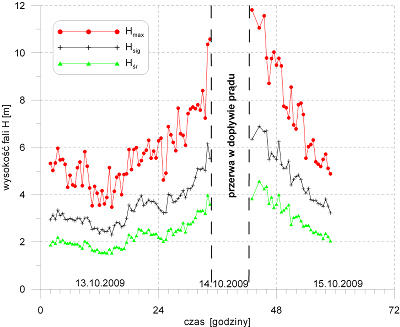 Sygnały pomierzone przez boję falową transmitowane były drogą radiową na ląd. Rejestracja falowania przez odbiornik i komputer odbywała się w pomieszczeniu Obchodu Ochrony Wybrzeża w Kątach Rybackich, udostępnionym przez Urząd Morski w Gdyni. Brak dostawy prądu uniemożliwił zapis falowania podczas szczytowej fazy sztormu. Niewykluczone, że wysokości fal w tej fazie trwania sztormu były wyższe od zapisanych wieczorem 14 października.
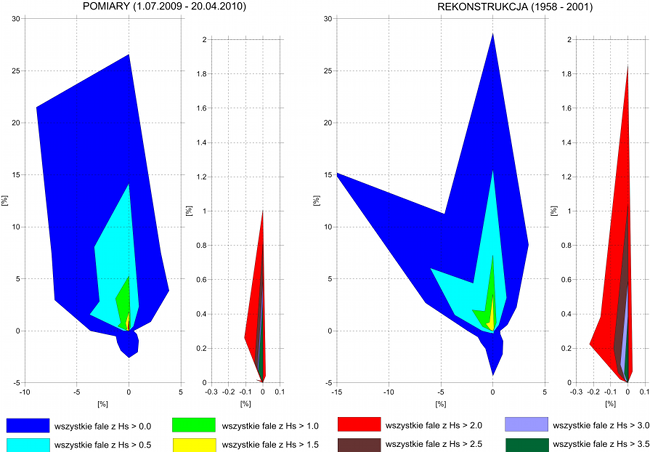 Z oglądu róż falowania wynika, że okres pomiarowy (1.07.2009 r. – 20.04.2010 r.) był nietypowy w porównaniu ze średnim falowym rokiem statystycznym, zrekonstruowanym dla wielolecia 1958-2001. W zakresie słabego i umiarkowanego falowania zwraca uwagę większa liczba fal podchodzących z kierunku NNW i mniejsza – z kierunku NW. Rezultaty obliczeń statystycznych dla falowania silnego i sztormowego dowodzą zdecydowanej dominacji intensywnego falowania z kierunku N zarówno dla okresu pomiarowego jak i dla okresu rekonstrukcji. Widać ponadto, że dziesięciomiesięczny okres pomiarów (pomimo zarejestrowania długotrwałego i ekstremalnie silnego sztormu) charakteryzował się znacznie krótszym czasem występowania intensywnych warunków falowych (z wysokością fali znacznej Hs < 2 m) niż średni rok statystyczny rekonstruowany dla wielolecia.
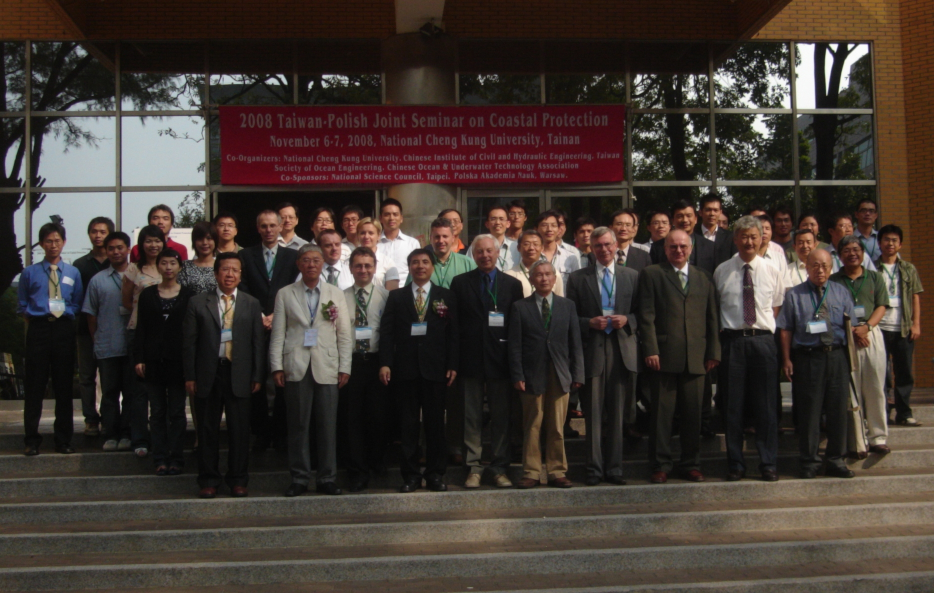 W dniach 6-7 listopada 2008 r. na Tajwanie odbyło się tajwańsko-polskie sympozjum pt. „2008 Taiwan-Polish Joint Seminar on Coastal Protection”. W seminarium, którego głównym organizatorem był National Cheng Kung University w Tainan (na południu Tajwanu), udział wzięła siedmioosobowa delegacja z IBW PAN. W ramach czterech sekcji tematycznych, nazwanych „Wind and Wave Climate”, „Coastal Morphodynamics”, „Impact of Climate Change on Coasts” i „Sustainable Coastal Development”, wygłoszono 7 referatów polskich i 13 tajwańskich.